Understanding the Connection Between Facial Expression, Emotion, and Qi
The relationship between facial acupuncture and emotions is one of the most fascinating areas where Traditional Chinese Medicine and modern neuroscience intersect.
Every smile, frown, look of surprise, or expression of concern involves far more than the movement of facial muscles. Each expression is part of a continuous conversation between the face, the brain, the nervous system, and—according to Traditional Chinese Medicine—the movement of Qi.
For thousands of years, TCM has recognized the face as more than a reflection of beauty. It is a mirror of health, vitality, and emotional balance. Modern neuroscience is now providing evidence that supports part of this ancient understanding: facial expressions don’t simply communicate emotion—they may also influence how we feel.
This fascinating relationship is known as the facial feedback hypothesis, and it has important implications for facial acupuncture.
Facial Acupuncture and Emotions
Most of us think of facial expressions as the result of emotion. We smile because we are happy. We frown because we are worried. We grimace because we are in pain. Research suggests the relationship is actually bidirectional.
When facial muscles contract, they send sensory information back to the brain through the trigeminal and facial nerves. That feedback may influence emotional processing, reinforcing or even modifying the emotional experience itself. In other words, the face doesn’t simply express emotion—it participates in creating it. This concept closely parallels Traditional Chinese Medicine, which views the face as an outward expression of the internal state of the body and mind.
When Emotion Leaves Its Mark
As acupuncturists, we often evaluate wrinkles from an anatomical perspective, but they also tell the story of a person’s emotional life. Every repeated facial expression gradually shapes the tissues beneath the skin. Years of smiling create one pattern of muscular activity. Chronic worry creates another. Habitual frowning, squinting, or clenching leaves its own signature on the face.
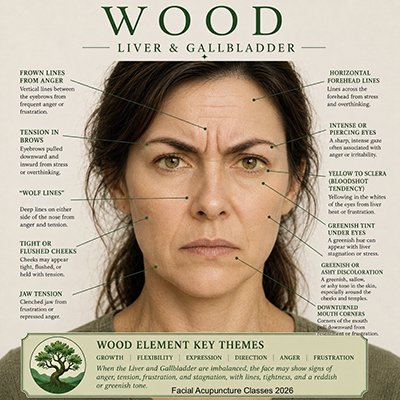
Traditional Chinese Medicine has long associated different facial regions with both organ systems and emotional tendencies. While these relationships should not be interpreted as rigid diagnostic rules, they provide another lens through which to understand our patients. A patient’s face often reflects not only the passage of time, but also decades of habitual expression, emotional adaptation, and physiological change.
The Role of Facial Acupuncture
This understanding changes the way we think about treatment. Facial acupuncture is not simply an aesthetic procedure designed to soften wrinkles. By improving circulation, reducing excessive muscle tension, restoring muscular balance, and supporting the free flow of Qi, treatment may influence both function and appearance.
Motor point acupuncture is particularly valuable because it addresses muscles that have become chronically hypertonic or weakened. Rather than treating only the visible wrinkle, we begin addressing one of its underlying contributors. Facial cupping, Gua Sha, microneedling, and LED therapy each influence different tissue layers and complement acupuncture by supporting tissue repair, fascial mobility, lymphatic drainage, and collagen remodeling.
What About Botox?
One of the more interesting discussions surrounding the facial feedback hypothesis involves botulinum toxin (Botox®).
By temporarily reducing activity in selected facial muscles, Botox can interrupt the normal feedback between facial expression and the brain. Some research has suggested this may influence emotional processing, although the relationship is complex and continues to be investigated. This doesn’t mean Botox is inherently good or bad. Rather, it reminds us that facial movement serves functions beyond appearance alone. As clinicians, understanding this broader context helps us have more informed conversations with our patients.
Looking Beyond the Wrinkle
Whether treating Bell’s palsy, synkinesis, facial pain, or cosmetic concerns, I believe it’s important to look beyond the wrinkle itself. The face is not simply skin stretched over muscle. It is a dynamic communication system involving connective tissue, muscles, nerves, circulation, emotional expression, and Qi. When we understand those relationships, we move beyond treating lines and folds. We begin treating the person who created them.
Watch the Video
In the video below, I explore the fascinating relationship between facial expression, emotion, and Qi, discuss the facial feedback hypothesis, and explain how these concepts influence my approach to facial acupuncture.
Learn More
Interested in facial acupuncture and emotions and incorporating these concepts into your practice?
Explore my Facial Acupuncture Certification Program, where we cover facial anatomy, motor points, cosmetic facial acupuncture, neuromuscular rehabilitation, microneedling, facial cupping, Gua Sha, LED therapy, and evidence-informed treatment planning through extensive hands-on training.
Continue Your Learning
Related Articles