Facial Motor Points and the Lower Face — What Most Acupuncturists Are Missing
If you practice facial acupuncture and treat the lower face — marionette lines, jowling, drooping mouth corners, lip lines — you are already working in the territory of the modiolus, whether you know it or not.
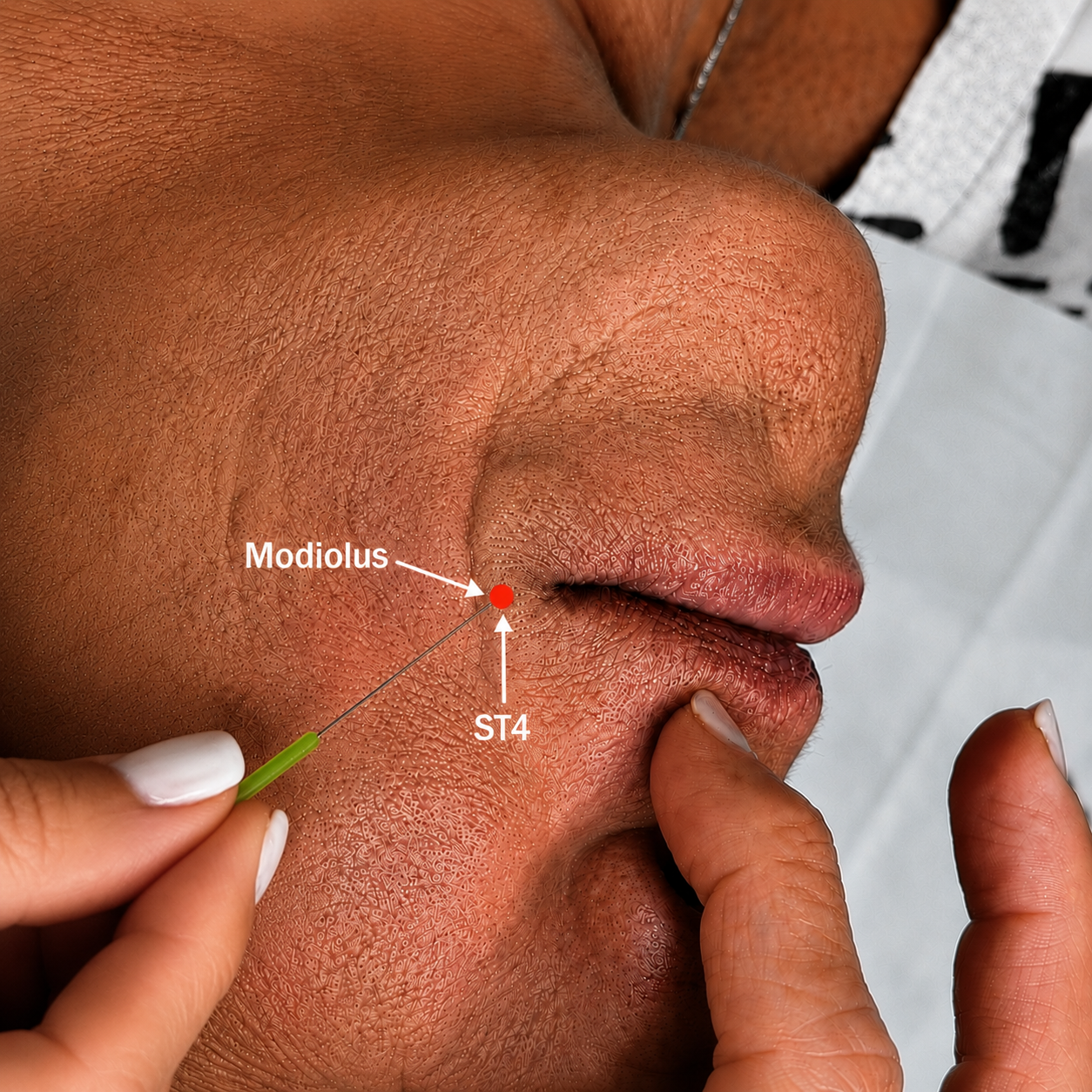
The modiolus is a small fibromuscular node at the corner of the mouth where up to ten facial muscles converge. It sits directly over ST-4 (Di Cang), one of the most classically important points in cosmetic acupuncture for the lower face. And understanding it changes how you think about facial motor points entirely.
Most facial acupuncture training teaches practitioners to locate and needle individual motor points, muscle by muscle. That approach has real clinical value — and I teach it in detail in my certification courses. But there is a more efficient strategy for treating the lower face that most practitioners never learn: targeting the convergence point itself.
In this article, I want to walk you through the anatomy of the modiolus, which muscles connect to it, how many have their own facial motor points, and why one well-placed needle at ST-4 can accomplish what might otherwise require thirteen separate insertions.
What Is the Modiolus?
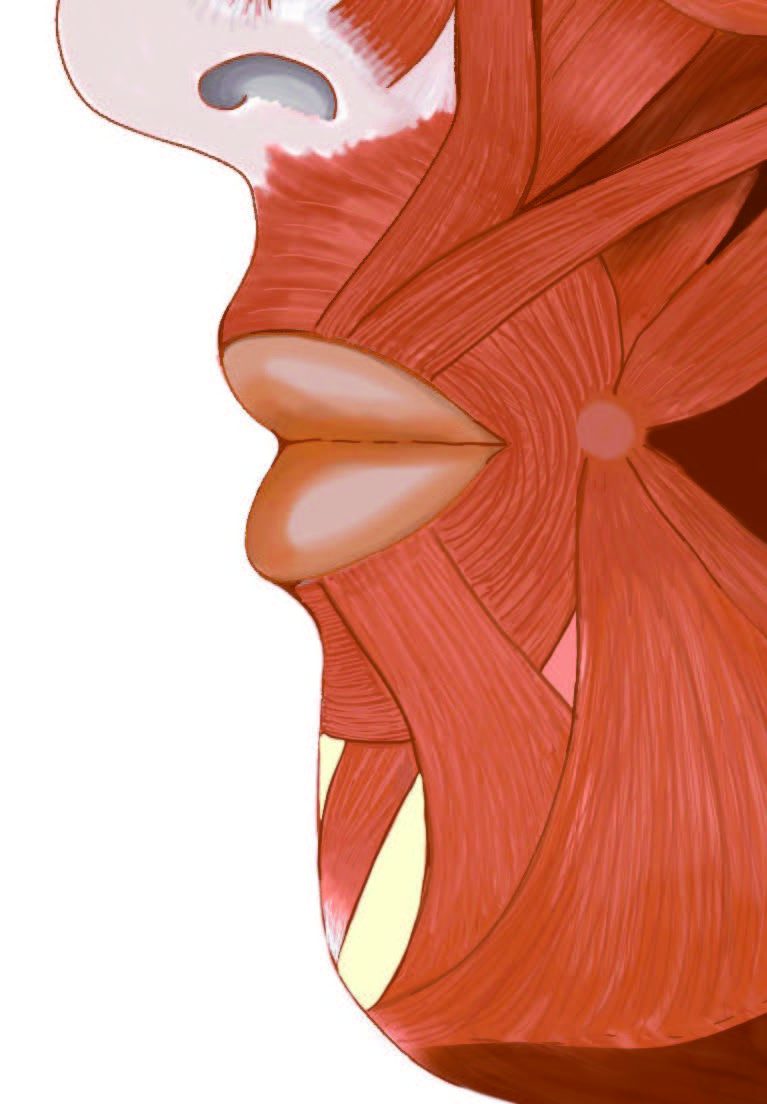
The modiolus (from the Latin word for the hub of a wheel) is a dense, mobile, fibromuscular node located at the corner of the mouth, approximately at the level of the acupuncture point ST-4. It is not a muscle itself — it is a convergence point where multiple facial muscles interdigitate and insert.
Think of it as a hub. Each muscle that connects to it is a spoke. When you needle the hub, you influence all the spokes simultaneously.
From a Chinese medicine perspective, ST-4 (Di Cang, or Earth Granary) sits directly over the modiolus. It is classically indicated for facial paralysis, deviation of the mouth, and difficulty chewing — all of which make complete sense once you understand what is happening anatomically at that location.
Which Muscles Connect to the Modiolus?
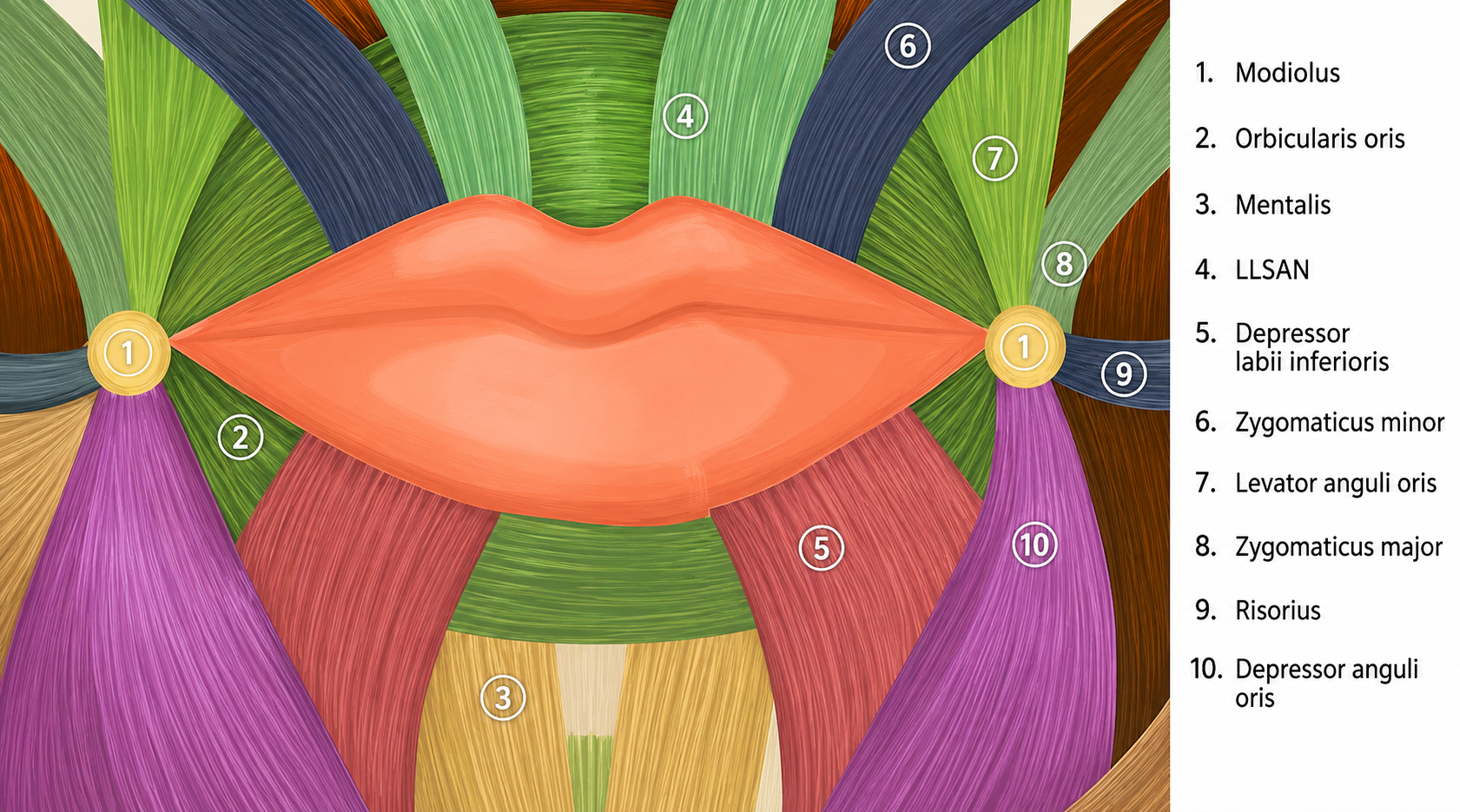
Ten muscles converge at or interdigitate with the modiolus in ways that are clinically relevant for facial acupuncture practitioners. An eleventh structure — the buccinator — also connects anatomically but is so deep to the other structures that it is not practically targetable with surface needling techniques and is generally outside the scope of standard facial acupuncture protocols.
The ten clinically relevant muscles are:
1. Orbicularis Oris
The circular muscle of the lips. Unlike most facial muscles, which have one motor point, the orbicularis oris has two motor points on each side — four total — reflecting its complex bilateral structure. It is responsible for lip closure, pursing, and the fine motor control of speech and expression. When it loses tone, lip lines deepen and the vermillion border loses definition.
2. Levator Anguli Oris (Caninus)
This muscle lifts the corner of the mouth upward and medially — it is the muscle of smiling. Its motor point is located deep to the zygomaticus major, making precise location important. When it weakens, the corners of the mouth begin to drift downward, contributing to the sad or tired appearance many patients describe.
3. Depressor Anguli Oris (Triangularis)
The direct antagonist of the levator anguli oris, this muscle pulls the corner of the mouth downward and laterally — it is the muscle of frowning. Overactivity or hypertonia of the depressor anguli oris is one of the primary drivers of marionette lines and downturned mouth corners. Its motor point sits just below ST-4 at approximately the level of CV-24 laterally.
4. Zygomaticus Major
One of the primary smile muscles, the zygomaticus major runs diagonally from the zygomatic arch down to the corner of the mouth. It is one of the more accessible motor points on the face and responds well to needling. Addressing the zygomaticus major contributes to lifting the nasolabial fold and restoring the upward arc of a youthful smile line.
5. Zygomaticus Minor
The smaller of the two zygomatic muscles, the zygomaticus minor runs parallel to the zygomaticus major and inserts into the upper lip and the corner of the mouth at the modiolus. It contributes to elevating the upper lip and deepening the nasolabial fold. While less discussed than its larger counterpart, it plays an important role in the overall lift and movement of the midface and is visible in the diagram as a distinct contributor to the modiolus complex.
6. Risorius
A small, thin muscle that pulls the corner of the mouth laterally — it is the muscle responsible for the dimple in those who have one. Because it is thin and variable in its development between individuals, its motor point can be less discrete than larger muscles. It contributes to the width and lateral pull of the smile.
7. LLSAN — Levator Labii Superioris Alaeque Nasi
The longest name in facial anatomy belongs to one of its most important muscles for cosmetic treatment. The LLSAN originates at the nasal bone and inserts into both the nostril and the upper lip, with fibers reaching the modiolus. It elevates the upper lip, flares the nostril, and when hypertonic contributes significantly to the depth of the nasolabial fold. Its motor point is located in the mid-cheek area between the nose and the upper lip. Addressing it helps restore the natural drape of the upper lip and reduces the depth of the nasolabial groove.
8. Depressor Labii Inferioris
This muscle depresses and everts the lower lip. It affects the appearance of the lower lip and chin area and, when overactive, can lead to a downturned or compressed lower lip. Its connection to the modiolus makes it relevant whenever treating the lower lip and chin complex.
9. Mentalis
The mentalis is the muscle of the chin — it raises and protrudes the lower lip and wrinkles the skin of the chin, creating the appearance sometimes described as an orange peel chin. Its fibers interdigitate with the modiolus complex and with the depressor labii inferioris and depressor anguli oris. Its motor point is located in the chin pad just above the mental crease. In clinical practice, addressing the mentalis is particularly valuable when treating chin ptosis, lower lip eversion, and the overall appearance of the lower face and jaw.
10. Platysma
The broad, sheet-like muscle of the neck and lower face. While not always depicted in anatomical diagrams of the modiolus, the superior fibers of the platysma interdigitate with the modiolus complex and with the depressor anguli oris — making it directly relevant to the downward pull on the lower face and jowl area. In my clinical practice and in my certification courses, I teach that treating the platysma in combination with the modiolus is one of the most effective approaches for addressing jowling, downturned mouth corners, and neck banding simultaneously. The platysma is the connection between the lower face and the neck, and ignoring it while treating the modiolus leaves a significant piece of the clinical picture unaddressed.
It is also worth noting that the buccinator — the deep cheek muscle — connects to the modiolus anatomically and does have a motor point located approximately at or just anterior to ST-6. However, because the buccinator lies deep to the other facial muscles, practical clinical access requires a depth of needling that falls outside standard facial acupuncture protocols. For this reason, I do not teach buccinator motor point needling in my certification courses, though its anatomical relationship to the modiolus is worth understanding.
Do All of These Muscles Have Their Own Motor Point?
A question I am often asked in my certification courses is: does every muscle connecting to the modiolus have its own motor point?
The answer is largely yes — with important nuances.
Most of the ten muscles described above have identifiable, clinically accessible motor points. In my book Treating the Face, I map these in detail, and in my certification courses, I teach practitioners how to locate and needle each one precisely.
The orbicularis oris, as noted, has four motor points rather than one — two on each side of the mouth — reflecting its bilateral and circular structure. This makes it anatomically unique among the muscles of the lower face.
The platysma has motor points, but because it is a broad, flat sheet rather than a discrete belly muscle, the point location is somewhat less precise than a smaller muscle. The clinical approach to the platysma involves needling along its fibers rather than targeting a single discrete motor point.
As noted in the previous section, the buccinator connects to the modiolus anatomically and has a motor point located approximately at or just anterior to ST-6. Because it lies deep to the other facial muscles, I do not teach buccinator motor point needling in my certification courses.
So in practical terms, a comprehensive individual motor point approach to the muscles of the modiolus would involve approximately thirteen needle insertions — the four orbicularis oris points plus one each for the nine remaining accessible muscles.
Why the Modiolus Changes Everything
Here is the clinical insight that makes the modiolus such a valuable treatment target.
Because all of these muscles converge and interdigitate at the modiolus, a needle placed precisely at ST-4 — and particularly when threaded toward or through the fibromuscular hub of the modiolus itself — creates a stimulus that propagates along the insertion fibers of multiple muscles simultaneously.
You are not just needling one structure. You are needling the point where ten muscles meet.
The clinical effects I observe from modiolus treatment include:
- Lifting of the mouth corner, as the levator anguli oris is stimulated and the depressor anguli oris is relaxed
- Reduction of marionette lines, as the downward pull of the depressor anguli oris and platysma is addressed
- Improvement in lower lip definition, as the orbicularis oris and depressor labii inferioris tone improve
- Softening of the nasolabial fold, particularly when combined with zygomaticus major and LLSAN treatment
- General lower face lift, as the convergence of muscles is stimulated toward better tone and coordination
This does not mean that individual motor point work is unnecessary. For specific conditions — Bell’s Palsy with discrete muscle involvement, for example, or significant asymmetry — targeting individual motor points is clinically essential and I teach both approaches in my certification curriculum.
But for general cosmetic facial acupuncture addressing the lower face, the modiolus is a point of extraordinary leverage. And understanding why requires exactly the kind of anatomical depth that most facial acupuncture training does not provide.
Threading the Modiolus
In my clinical experience, the most effective needling approach to the modiolus is a threading technique that begins at ST-4 and directs the needle into the fibromuscular body of the modiolus.
In my certification courses, I teach this as part of the comprehensive lower face protocol, always in the context of a full constitutional treatment that addresses the underlying Chinese medicine diagnosis driving the patient’s aging pattern.
This is one of the reasons I consistently emphasize that facial acupuncture is not simply a cosmetic procedure performed on the face in isolation. The face reflects the whole. The modiolus is a beautiful example of that principle — a small, dense convergence point that, when understood and needled correctly, reveals how structurally interconnected the face truly is.
Clinical Takeaway
The next time you are treating a patient with marionette lines, downturned mouth corners, or jowling, consider the modiolus as your primary target rather than beginning with individual motor point mapping.
Needle ST-4. Thread toward the fibromuscular hub. Then assess which individual muscles may need additional attention based on the specific presentation in front of you.
One point. Multiple muscles. More efficient treatment. Better outcomes.
Learn This Hands-On
If you want to learn facial motor point technique — including modiolus needling, threading, and the complete lower face protocol — I teach this in my Facial Acupuncture Certification courses held throughout the US and internationally.
Upcoming classes:
- Toronto, Canada — July 25–26, 2026 (CCNM)
- Boulder, CO — September 12–13, 2026
- Tokyo, Japan — November 14–15, 2026
- Bradenton, FL — January 16–17, 2027 (Dragon Rises College)
- Feb 2027-Auckland, NZ-Sydney, AU
I also cover the modiolus, motor points, and lower face anatomy in Module 2 (Theory and Protocols) and Module 5 (Advanced Protocols) of my online CEU course series, available anytime at FacialAcupunctureClasses.com.
My book Treating the Face: A Comprehensive Guide for Acupuncturists and Health Professionals includes detailed diagrams of all motor points and the modiolus-attached muscles — Chapters 4 and 7 are particularly relevant to the content of this article.
About the Author
Michelle Gellis, AP DiplAc MAc LAc, is one of the few acupuncturists in the United States certified to teach facial acupuncture certification courses nationally. She has been teaching facial acupuncture internationally since 2006 and is the author of Treating the Face: A Comprehensive Guide for Acupuncturists and Health Professionals. She is a Doctoral Faculty member at Yo San University and an approved CEU provider for NCCAOM, California, Florida, and Texas boards.
FacialAcupunctureClasses.com