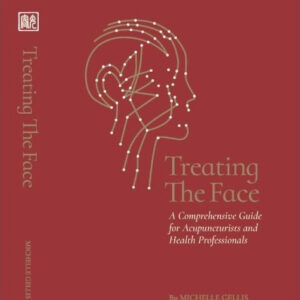
 By Michelle Gellis, AP LAc DiplAc, from her book “Treating the Face: A Comprehensive Guide for Acupuncturists and Health Professionals“
Our face is an outward reflection of our inner world. In Chinese medicine, this concept is expressed through biao li (表裏) — the relationship between exterior and interior. The character biao (表) refers to what is visible on the surface, while li (裏) refers to what lies within. Together, they explain how internal states manifest externally.
The Huangdi Nei Jing states: “All the Qi and Blood of the meridians pour upwards into the face.” The complexion is especially significant: the Su Wen (Chapter 10) attributes it to the Heart, while the Nan Jing (Chapter 49) assigns it to the Liver. Changes in the face therefore signal internal disharmony.
According to Chinese physiognomy, each region of the face corresponds to a specific organ system. When that system is imbalanced, the complexion, texture, or moisture of the associated area will change.
Facial Colors in Diagnosis
The Nan Jing emphasizes facial color assessment as one of the pillars of diagnosis. Chapter 61 states: “Anybody who looks and knows is to be called a spirit,” referring to a practitioner’s ability to recognize the five colors and link them to patterns of health or illness.
-
White (Metal): Seen over the whole face. Dull white suggests blood deficiency; bright white points to qi or yang deficiency.
-
Blue (Water): Most visible under the eyes. Dark blue or black indicates Kidney deficiency.
-
Green (Wood): Often on the temples. Suggests Liver disharmony or qi/blood stagnation.
-
Red (Fire): Rises from the neck to the cheeks. Diffuse redness suggests excess heat; a malar flush suggests yin deficiency.
-
Yellow (Earth): Appears around the mouth. Pale yellow points to Spleen qi deficiency; orange-yellow indicates damp-heat.
Flashes of red or green may appear and fade quickly, whereas white, yellow, and blue often persist longer.
Facial Lines and Emotional Expression
Beyond color, facial lines reveal emotions and life experiences.
-
Joy lines: Extend upward from the outer canthus of the eyes.
-
Sadness lines: Curve downward from the outer canthus; long, deep lines suggest profound grief or depression.
-
Skepticism lines: Run horizontally across the forehead. According to Leon Hammer, each line corresponds to a significant trauma or ordeal in life.
The shape of the forehead, chin, eyes, and sensory organs also provide diagnostic insights. The eyes, in particular, are considered the windows of the shen (spirit). Bright, clear eyes indicate vitality; dull or lifeless eyes suggest disturbance of the shen.
Aging and the Five Elements
How the face ages provides further diagnostic information. Each element governs certain facial qualities, and imbalance accelerates visible aging.
-
Fire (Heart, Small Intestine, Pericardium, San Jiao): Excess Fire manifests as redness, broken capillaries, or blemishes. Deficiency may cause puffiness, dryness, or dark circles under the eyes.
-
Earth (Stomach, Spleen): Weak Spleen qi leads to sagging skin, loss of tone, puffiness, and bags under the eyes. Pensiveness contributes to lines around the lips and nose.
-
Metal (Lungs, Large Intestine): Governs skin health. Impairment leads to dryness, thin or inelastic skin, clogged pores, or diffuse wrinkles, especially around the mouth.
-
Water (Kidneys, Bladder): Deficiency accelerates aging. Dark under-eye circles, puffiness, forehead lines, and chin wrinkles often relate to Kidney yin or yang weakness.
-
Wood (Liver, Gallbladder): Anger and Liver qi stagnation create furrows between the brows and lines beside the nose. Deficient Liver blood may cause dryness; stagnation can create dark spots.
The Face as Diagnostic Map
In practice, face diagnosis allows practitioners to gain insights into a patient’s physical and emotional state that may not be spoken. From complexion changes to subtle shifts in expression, the face offers clues about the flow of qi, blood, and spirit.
Through acupuncture and related therapies, we can restore balance, improve circulation to the face, and allow for healthy expression. The face is more than what we show the world—it is a living map of our health and emotions.
References excepted from book:
- Kaptchuk, T.J. (2000). The Web That Has No
Weaver. New York: McGraw-Hill Professional.
- Unschuld, P. (2016). Nan Jing. The Classic of
Difficult Issues. Oakland: University of
California Press.
- Bridges, L. (2004). Face Reading in Chinese
Medicine. St. Louis, MO: Churchill
Livingstone.
- Hicks, A., & Hicks, J. (2004). Five Element
Acupuncture. London: Churchill Livingstone:
- Veith, I. (1972). The Yellow Emperor’s Classic
of Internal Medicine. Berkeley: University of
California Press, 140.
- Beinfield, H., & Korngold, E. (1992). Between
Heaven and Earth: A Guide to Chinese
Medicine. New York: Ballantine.
- Gellis, M. The anatomy of expression
[Webinar]. Retrieved from https://
facialacupunctureclasses.com/the-anatomyof-
expression/.
- Parker, H. Tic disorders and twitches.
Retrieved from https://www.webmd.com/
brain/tic-disorders-and_twitches#1.
- Martel, J. (2019). Facial tic disorder. Retrieved
from https://www.healthline.com/health/
facial-tics.
Michelle Gellis teaches cosmetic and neuromuscular facial acupuncture classes internationally. Her live and recorded classes are available at facialacupunctureclasses.com